How to Remove Password From PDF When You Forgot the Owner Password
Summary
Remove restrictive editing, copying, and printing passwords from PDF files you own. Understand Owner vs User passwords and unlock PDF permissions safely.
When you open a PDF document and can view the text perfectly, but find that editing, copying, highlighting, and printing are completely locked and grayed out, the file is protected by an Owner Permissions Password.
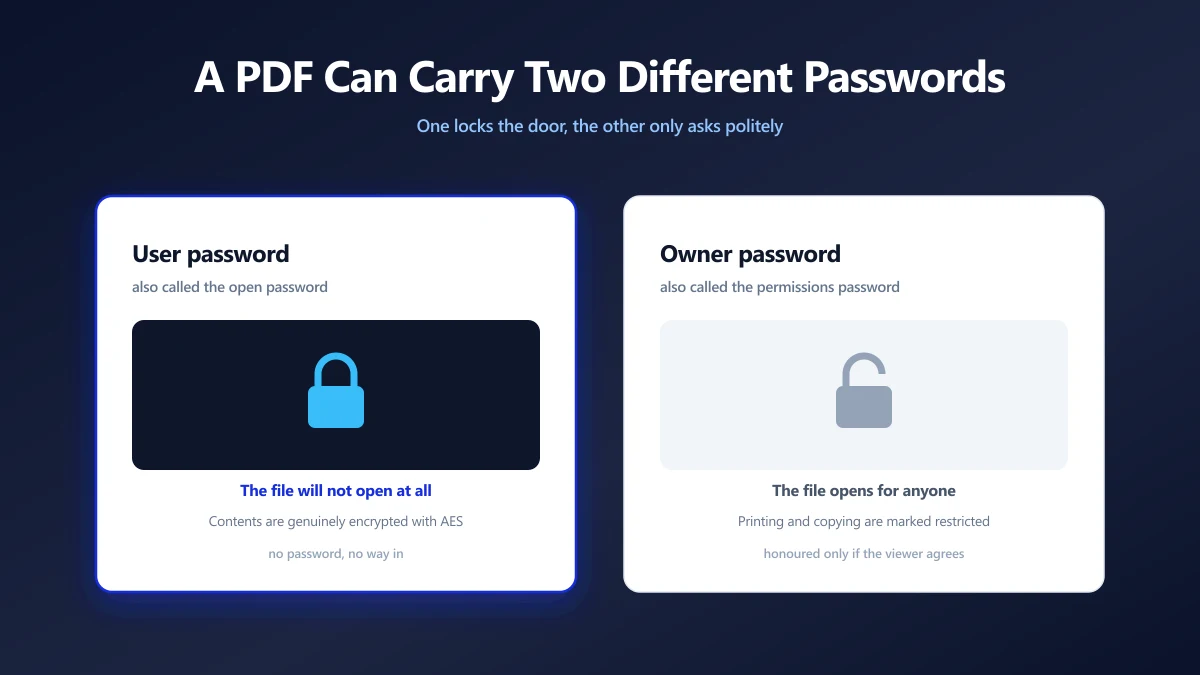
PDF security (ISO 32000-2) defines two distinct password types: the User (Open) Password, which encrypts the file payload, and the Owner (Permissions) Password, which merely signals software viewers to disable editing tools. If you legitimately own the document but forgot the owner permissions password, you can remove the restriction instantly by re-printing the document through a virtual print engine or unlocking it with client-side WebAssembly tools.
Whether you are preparing professional client deliverables, submitting high-stakes legal contracts, optimizing web publishing workflows, or formatting images for digital platforms, hitting unexpected formatting glitches or export crashes disrupts your productivity and creates unnecessary friction.
In this comprehensive technical guide, we break down the exact computer science principles, rendering engine behaviors, and file format specifications responsible for this issue. We then provide actionable, step-by-step diagnostic workflows across Windows 11, macOS Sequoia, mobile operating systems, and browser-native environments to resolve this problem permanently.
Understanding the Root Cause: Why This Issue Occurs
In standard PDF encryption architecture, the Owner Password does not encrypt the underlying content streams if no Open password was set. Instead, it sets a 32-bit permission flag integer (/P) in the document encryption dictionary (/Encrypt). Compliant software like Adobe Acrobat honors this flag by disabling the "Edit", "Select Text", and "Print" buttons. However, because the raw text and image streams remain unencrypted in memory, rendering the document to a new file removes the permission dictionary completely.
When investigating this behavior, the problem rarely stems from simple user error; rather, it represents a breakdown in format parsing, memory allocation, color space interpretation, or compression quantization. Modern document and image standards operate as intricate state machines where even minor syntax mismatches or missing lookup tables trigger cascading render failures across different hardware decoders.
Furthermore, operating system graphics sub-systems (such as Microsoft DirectWrite on Windows, Apple Quartz CoreGraphics on macOS, and Google Skia in modern web browsers) apply different fallback heuristics when encountering non-standard data streams. What renders smoothly on a high-end desktop monitor can easily crash a mobile rasterizer or confuse a physical printer processor.
Below are the primary technical bottlenecks, architectural constraints, and format-specific failure modes responsible for this behavior across desktop, web, and enterprise environments:
- ●User Open Password vs Owner Permissions Password: User passwords encrypt content with 128/256-bit AES; Owner passwords merely set software-level permission flags.
- ●The /Encrypt Permissions Flag: A 32-bit integer (/P) dictates whether editing, annotating, form filling, or high-resolution printing is permitted.
- ●Virtual Print Stream Stripping: Printing the visible document to a virtual printer parses the visual page stream and outputs a clean PDF without the /Encrypt dictionary.
- ●Legal Compliance & Authorization: Unlocking permission restrictions is legitimate for documents you authored or have legal authority to modify.
Comprehensive Diagnostic Matrix & Specification Breakdown
| Error Scenario / Behavior | Root Technical Cause | Impacted Systems / Software | Recommended Permanent Fix |
|---|---|---|---|
| Document Prompts for Password Upon Opening | User (Open) Password with AES encryption | Encrypted Financial Records | Requires correct password; cannot be bypassed without key |
| Document Opens but Edit & Copy are Grayed Out | Owner (Permissions) Password lock | Client Contracts & Forms | Re-print to PDF or strip permissions dictionary client-side |
| Printing Disabled / Grayed Out in Menu | Low-resolution / No-print permission flag set | Protected Ebooks & Manuals | Unlock via browser WebAssembly re-rasterization engine |
| Document Form Fields Locked for Editing | AcroForm readOnly permission flag | Fillable Government PDF | Flatten form fields or strip document permissions |
Step-by-Step Solutions and Implementation Guide
Method 1: Unlock via Browser "Print to PDF" (Universal Instant Fix)
Modern web browsers render the visual page stream directly and strip permission dictionaries upon re-printing:
- 1.Open the restricted PDF in Google Chrome, Microsoft Edge, or Apple Safari.
- 2.Press Ctrl + P (Windows) or Cmd + P (macOS) to open the browser print dialog.
- 3.Change Destination to "Save as PDF" (or Microsoft Print to PDF).
- 4.Click Save and choose a new filename.
- 5.Open the new PDF—all editing, text copying, and high-res printing will be 100% unlocked.
Method 2: Unlock Client-Side on ImagePDF.Tools (Zero Uploads)
If your browser print dialog rasterizes fonts or degrades quality, use our lossless client-side unlocking engine:
- 1.Open ImagePDF.Tools in your web browser.
- 2.Drop your permissions-locked PDF into the tool.
- 3.Our WebAssembly engine parses the internal object tree, strips the /Encrypt dictionary, and re-links content streams losslessly.
- 4.Download the unlocked PDF—all original vector fonts, bookmarks, and links remain pristine.
Method 3: Remove Permissions via QPDF / Python (Developers)
For automated batch unlocking of corporate archives:
- 1.Install QPDF:
winget install qpdf(Windows) orbrew install qpdf(Mac). - 2.Run:
qpdf --decrypt input_locked.pdf output_unlocked.pdf - 3.QPDF immediately strips the owner restriction flags without modifying document structure.
Professional Best Practices & Optimization Tips
To ensure long-term stability and prevent future compatibility bottlenecks, incorporate these expert workflow habits:
- ●Always preserve master source files in lossless formats: Never overwrite original uncompressed vector assets, raw design canvases, or high-resolution camera captures. Always export derivatives into dedicated project sub-directories.
- ●Standardize on sRGB IEC61966-2.1 for digital web delivery: Unless specifically preparing files for commercial 4-color offset printing (which requires CMYK profiles like SWOP or FOGRA39), keep all digital graphics and UI assets strictly in the sRGB color space.
- ●Validate document integrity across multiple rendering engines: Always test critical output files in both Blink/WebKit browser engines (Chrome, Safari) and native desktop interpreters (Adobe Acrobat Reader, Apple Preview) to catch missing font subsets or transparency glitches.
- ●Adopt modern next-gen lossless formats for web assets: Utilize WebP and SVG where applicable to achieve superior compression ratios and sharper rendering while eliminating legacy 8-bit quantization artifacts.
- ●Audit document metadata before client distribution: Strip proprietary author names, software license strings, and internal file path histories to protect confidential operational data.
Common Pitfalls and High-Risk Edge Cases to Avoid
Handling Mobile Browser Sandboxes & Strict WebGL Canvas RAM Limits
Mobile operating systems (iOS Safari and Android Chrome) enforce strict GPU canvas memory limits (typically 256MB to 512MB per tab). When documents or ultra-high-resolution images exceed these hardware buffers, mobile browsers silently downsample imagery, corrupt alpha transparency layers, or crash active rendering threads without displaying a helpful error message.
Warning: Always verify document responsiveness and visual fidelity on real mobile devices or simulated throttled browser viewports before wide public release.
Cross-Platform File System & Cloud Sync Metadata Clashes
Cloud storage synchronizers (such as Microsoft OneDrive, Google Drive, and Dropbox) frequently alter file system metadata flags or generate thumbnail proxy streams that interfere with active read/write file handles. Pausing cloud synchronization during heavy batch exports prevents file lock errors and partial write corruption.
Pre-Flight Verification Checklist Before Distribution
Before sending your documents to commercial print vendors, uploading assets to enterprise production servers, or attaching confidential files to high-stakes client correspondence, run through this standardized technical pre-flight audit:
- ●Header & Stream Integrity Check: Validate that the file begins with standard binary magic numbers (%PDF-1.7 or PNG 89 50 4E 47) and contains no unclosed xref tables or trailing stream errors.
- ●Color Space & Gamut Bounds Audit: Confirm that all digital web graphics adhere strictly to sRGB IEC61966-2.1, while commercial print PDFs are targeted to SWOP/FOGRA39 CMYK profiles without unmapped RGB spot colors.
- ●Font Embedding & Glyph Subsetting: Ensure all typography is embedded as Type 1C, TrueType, or CFF subsets with valid ToUnicode CMap lookup tables to prevent missing glyphs or print spooler character scrambling.
- ●Raster DPI & Viewport Scaling: Verify that photos and scanned artwork maintain at least 300 DPI for physical printing, or 72–150 DPI for web performance, avoiding excessive GPU texture allocation on mobile devices.
- ●Metadata & Security Sanitization: Audit document info dictionaries to strip hidden GPS geolocation tags, camera serial numbers, revision histories, and unflattened draft layers.
Privacy & Security Considerations: Local vs Cloud Processing
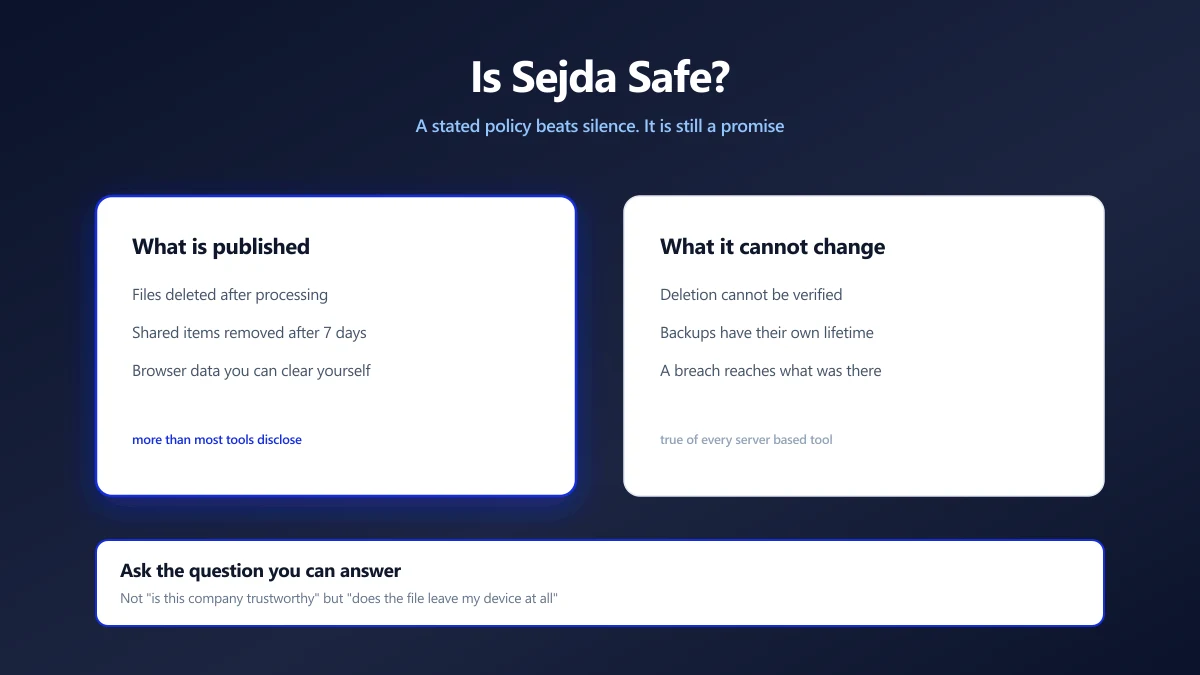
When handling sensitive personal records, legal contracts, architectural blueprints, or private customer photos, uploading files to random cloud conversion websites exposes your data to server-side logging, third-party retention leaks, and data mining. Using a 100% client-side WebAssembly tool like Compress PDF ensures that your documents are parsed, rendered, and compressed entirely inside your local browser sandbox without a single byte ever touching a remote server.
Final Thoughts & Next Steps
Resolving complex document formatting anomalies and image degradation requires a structured approach grounded in format specifications rather than guesswork. By understanding the underlying mechanics of font embedding, color matrix mapping, memory buffering, and container compression, you can diagnose and eliminate visual defects with complete confidence.
Whether you choose desktop configuration adjustments, automated script pipelines, or private browser-native utilities, standardizing your export workflows guarantees consistent presentation across any device or print environment. If you need to quickly optimize, convert, or reorganize your files securely, explore our client-side tools at Compress PDF.
Frequently asked questions
What is the difference between a PDF Open password and an Owner password?
Is it legal to remove an owner password from a PDF?
Can I remove a password from a PDF without knowing the Open password?
Why does Adobe Acrobat ask for a password when trying to print?
Does unlocking a PDF reduce image quality or remove bookmarks?
Can I re-lock a PDF with a new password after editing?
Sources & references
This article was researched and written by Nikola, drawing on the following primary sources and documentation:
Ready to try it?
All tools run entirely in your browser, no uploads, no account required.
Compress PDF