
Compress an Image to Under 20 KB
or drop files here
20 KB is one of the tightest limits still in common use, and it is nearly always a signature box or a small photo field. Drop your image in and it is compressed down to fit.
Can every image reach 20 KB?
A cropped signature or a small head and shoulders photo reaches 20 KB comfortably. A full page document scan will not, at any quality setting, because a page of text needs enough pixels to resolve the letters and below that threshold the text stops being readable rather than merely soft.
Signature fields
Exam and recruitment portals commonly cap the signature image at 20 KB, separately from the photograph.
Thumbnail uploads
Older systems that store a small avatar or list thumbnail rather than a full image.
Legacy government forms
Limits set when storage was priced very differently, and never revised since.
Pixels first, then quality.
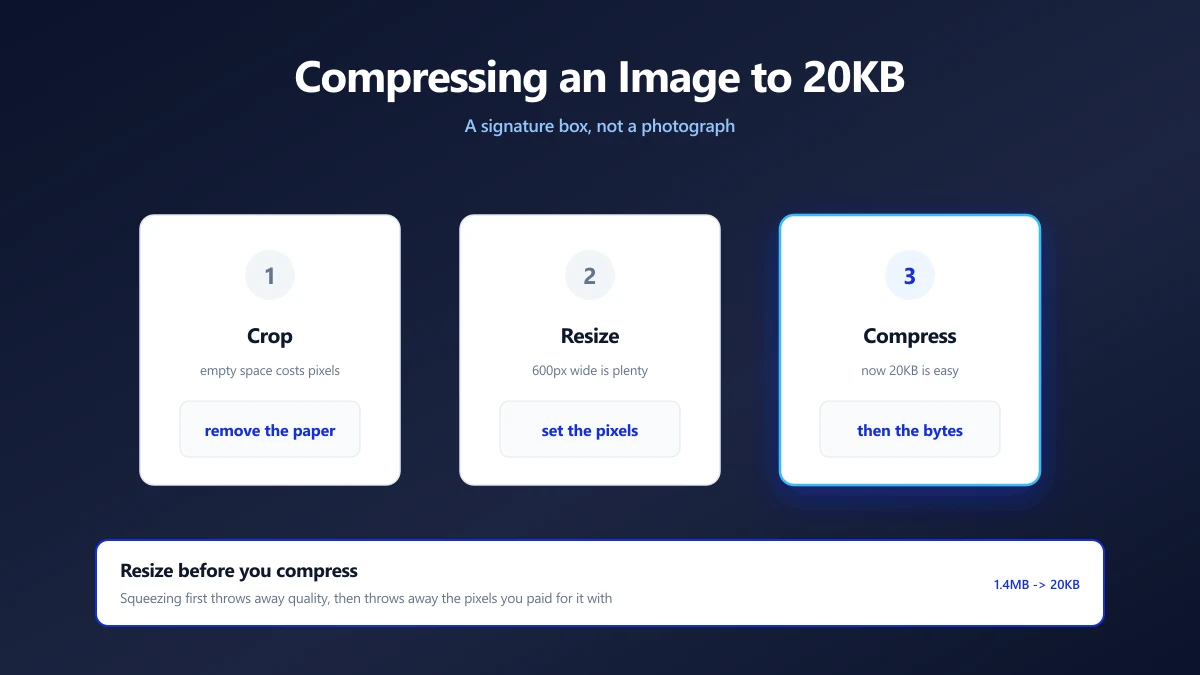
File size follows from pixel count. Squeezing a 4000 pixel wide photo down to a small target asks the encoder to describe twelve million pixels in a few kilobytes, and it will, badly. Reduce the dimensions first and the same target becomes easy.
Crop away what is not the subject
Paper around a signature, desk around a document, background around a face. Empty space costs pixels like anything else.
Resize to what is needed
Around 600 x 200 px for a signature, or 300 x 400 px for a photo.
Then compress to the limit
Quality comes down until the file is under 20 KB, and stops there. Aim just under the limit rather than far below it: unused bytes are quality discarded for nothing.
Need a different size?
Pick the limit you actually have to meet, or set any figure you like on the main compressor.
Questions answered.
Can a document scan fit in 20 KB?
Why is my scanned signature so large to begin with?
Should I use JPEG or PNG for a signature?
How does it hit an exact size?
Should I resize before compressing?
Is my image uploaded anywhere?
What if the target cannot be reached?
More tools you might need.
Related Guides & Tutorials
How to Compress an Image to 20KB (Signatures and Thumbnails)
20KB is a signature box, not a photograph. What actually fits, the dimensions that get you there, and why scanning at 600 DPI is working against you.
How to Compress a Photo to 50KB for an Exam Form
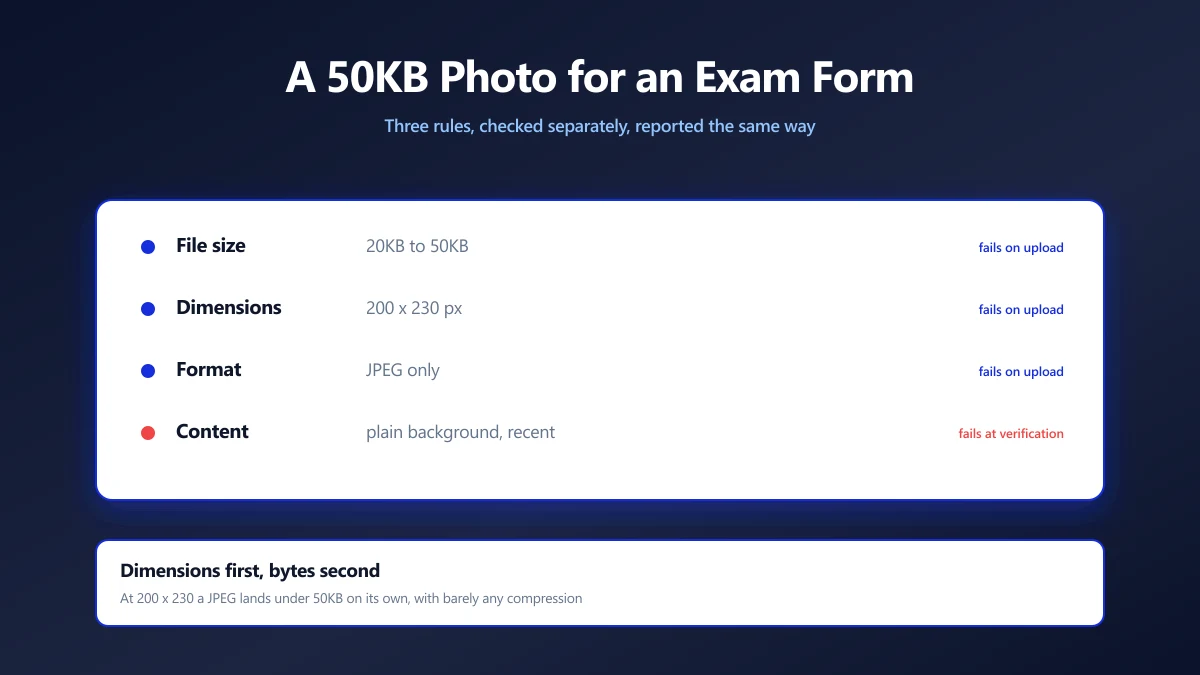
Exam portals want a photo under 50KB at a fixed pixel size, and reject it for reasons they never explain. Here is how to satisfy both rules at once.
How to Compress an ID Document Scan to 100KB and Keep It Readable
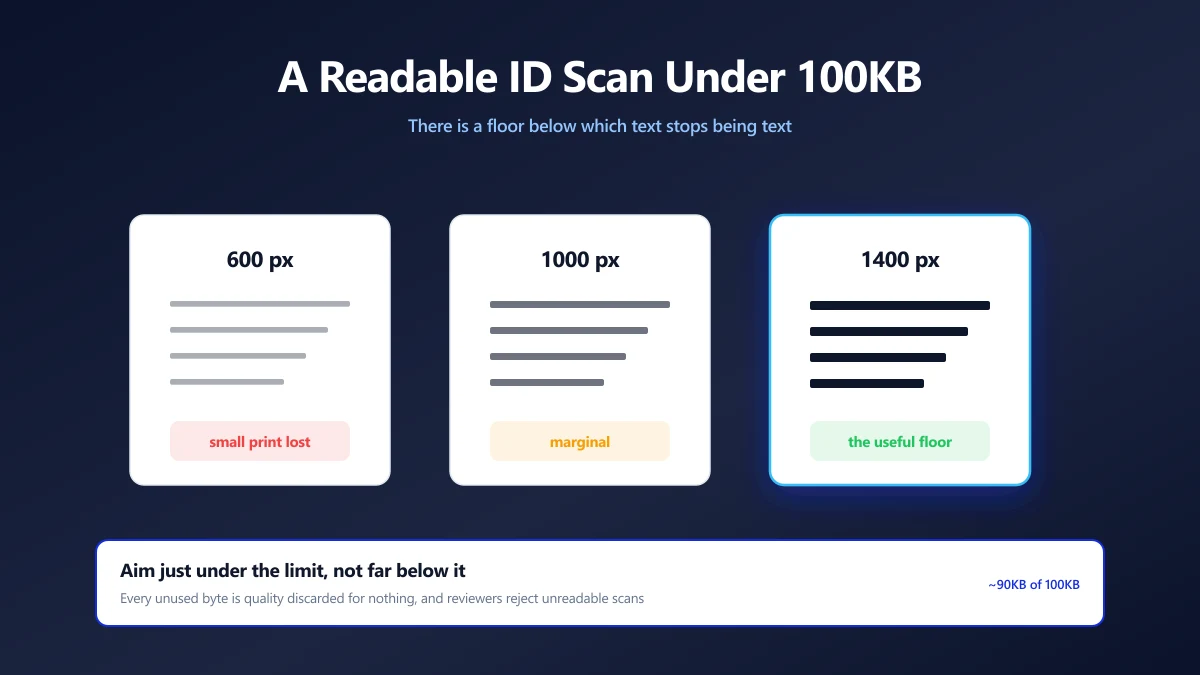
KYC portals want your ID under 100KB, then reject it as unreadable. The resolution floor that keeps text legible, and how to compress down to it.